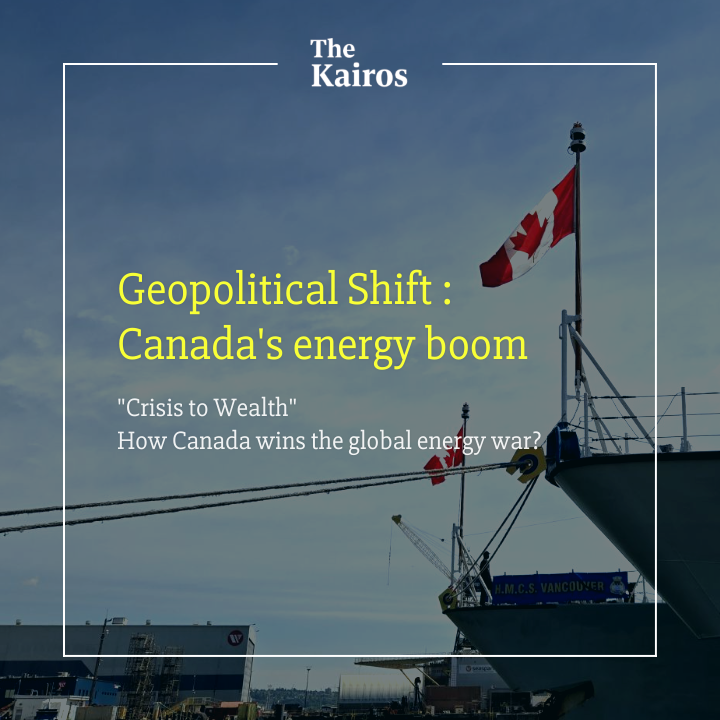
Geopolitical Crisis: Why Canadian Assets Are Gaining Attention… Expanding Oil & LNG Exports
Why is Canada winning the global energy war? Reasons why Canadian assets are highlighted amid geopolitical risks… Prospects for expanded oil and LNG exports.
With the US and Israeli airstrikes on Iran and the subsequent blockade of the Strait of Hormuz, the entire Middle East has effectively become a battlefield. The blockade of Hormuz—historically the world’s most critical chokepoint for crude oil and LNG traffic—has starkly exposed the vulnerabilities of global energy supply chains. Consequently, Canadian oil and LNG, widely regarded as a geopolitical “safe haven,” are drawing significant attention from global markets.

The Geopolitical Case for Canadian Energy Assets
- Canada, the World’s 4th Largest Oil Producer: Recently completed the Trans Mountain Pipeline (TMX) expansion.
- LNG Canada, Commencing Operations This Year: Exports to Asian nations, including South Korea, China, and Japan, are actively underway.
Let’s dive deeper into Canada, a nation rapidly emerging as a critical alternative in the global energy supply chain amid escalating geopolitical risks.
Canada’s S&P/TSX Composite Index: 30% Financials + 20% Energy … “A Strong Upward Momentum” Canadian Dollar (CAD): Potential for ‘Currency Appreciation’ driven by rising commodity prices.
Generally, when specific commodity prices rise, the currency of the exporting nation tends to appreciate. As a premier resource-rich country, Canada has a high probability of seeing its currency value rise in tandem with soaring crude oil and natural gas prices.
Notably, the composition of Canada’s benchmark index (S&P/TSX)—where the financial sector accounts for roughly 30% and the energy sector 20%—suggests that this macro environment could act as a powerful growth engine for the Canadian stock market.

The Canadian stock market has already demonstrated strong performance since the beginning of 2025. It has posted yields of over 30% year-to-date, peaking at around 55% during this period. While the US stock market is heavily concentrated in tech-driven growth stocks, the Canadian market is anchored by value and blue-chip stocks, primarily in the financial and energy sectors.
From a portfolio construction perspective, a blended investment approach combining US and Canadian equities is well worth considering.
- (Example): SPY ETF + EWC ETF
- iShares MSCI Canada ETF (EWC): A US-listed ETF that invests directly in the Canadian stock market.
- Note: EWC is an unhedged ETF, meaning its returns are tied to the value of the Canadian Dollar (CAD).
Canadian Oil & Natural Gas: Expanding into Asian Markets “Lacking the Infrastructure to Fully Support the Global Commodity Supply Chain”
Even though the Trans Mountain Pipeline expansion is complete, severe logistical constraints remain, hindering Canada’s ability to fully act as a primary global commodity supplier.
The pipeline now handles 890,000 barrels per day. However, the Burnaby export terminal cannot accommodate Very Large Crude Carriers (VLCCs). It is physically limited to receiving only Aframax-class vessels (which hold about 800,000 barrels per shipment).
- Incapable of receiving VLCCs.
- Result: A significant portion of Canadian crude must still be diverted to VLCC export terminals in the US Gulf Coast to reach global markets efficiently.
For Canadian crude oil exports to scale meaningfully, upfront infrastructure investments—such as expanding existing ports or building new deep-water export terminals—are a prerequisite.
On a brighter note, the LNG Canada project (which includes KOGAS) is built on a deep-water port capable of docking massive, state-of-the-art LNG carriers.
- LNG Canada: A joint venture project involving Shell, Mitsubishi, PetroChina, KOGAS, and Petronas.
Conclusion: Geopolitical risks originating from the Middle East have undoubtedly boosted the appeal of Canadian oil and natural gas. However, there are realistic limitations to exporting Canadian crude rapidly and at a massive scale due to infrastructural bottlenecks.
Nevertheless, in an environment where the Strait of Hormuz is blocked and Middle Eastern energy supplies are highly volatile, global demand for Canadian oil and natural gas will inevitably rise. By exporting to Asia at prices relatively higher than previous US-bound rates, the net profit margins of Canadian energy companies are expected to improve considerably.
✔️ Why were US selling prices historically so low? Because the United States was essentially the only export route for Canadian oil. In a situation with no alternative buyers, the Trans Mountain Pipeline expansion has finally created a new export channel across the Pacific. As the notorious discount on Canadian crude narrows, the profitability of Canadian energy firms is noticeably improving.
“If the opportunity arises, I plan to analyze the broader economic growth potential of Western Canada, including the Greater Vancouver area, in a future post.”
Investment Precautions & Market Risks
- Extreme Volatility in Energy Markets: The situation in the Strait of Hormuz remains highly fluid. The official implementation of this toll, or any physical blockades, could trigger sudden and severe price swings in crude oil futures (WTI, Brent) and energy-related equities.
- Geopolitical Unpredictability: Investors focusing on the defense sector and macro-driven ETFs should closely monitor the diplomatic or military responses from the US, Israel, and allied nations. Unforeseen military escalations or the imposition of tighter sanctions can rapidly alter the global risk landscape.
- Macroeconomic and Inflationary Ripple Effects: A sustained 5–10% increase in everyday pump prices could reignite global inflationary pressures. This scenario may force major central banks (such as the Federal Reserve, the Bank of Canada, or the Bank of England) to delay anticipated interest rate cuts or maintain restrictive monetary policies for a longer duration.
- General Disclaimer: The insights and analysis provided on The Kairos are for informational and educational purposes only and should not be construed as professional financial or investment advice. Always conduct your own due diligence or consult with a licensed financial advisor before making investment decisions based on unfolding geopolitical events.

Leave a Reply