How Long Will the US-Iran War Last? Oil, Arms, and Macro economy
The Macro Shockwaves of the US-Iran Conflict: Inflation, Geopolitics, and Defense ETFs
Key Takeaways:
- The possibility of a prolonged US-Iran war is rising, bringing the risk of economic recession triggered by surging oil prices and depleted weapon inventories.
- The US is already stretched thin, fighting indirect wars by supporting Ukraine and Israel.
- A massive disruption in Middle Eastern crude oil exports is heavily weighing on global markets.
Beyond the headlines, we need to closely examine the tactical details and macroeconomic implications of the ongoing war between the United States and Iran.
Iran is essentially a natural fortress. It boasts a population of nearly 90 million, and its geography—stretching from the Gulf to Tehran—is dominated by harsh deserts and rugged, mountainous terrain. Consequently, deploying ground troops carries astronomical risks. At this stage, the US and Israel are strictly focusing on targeted airstrikes against key facilities, seemingly hoping to incite a civilian uprising that leads to a regime change.
The critical question for the markets is: Can this war drag on?

1. The Timeline and “Weapons Depletion”
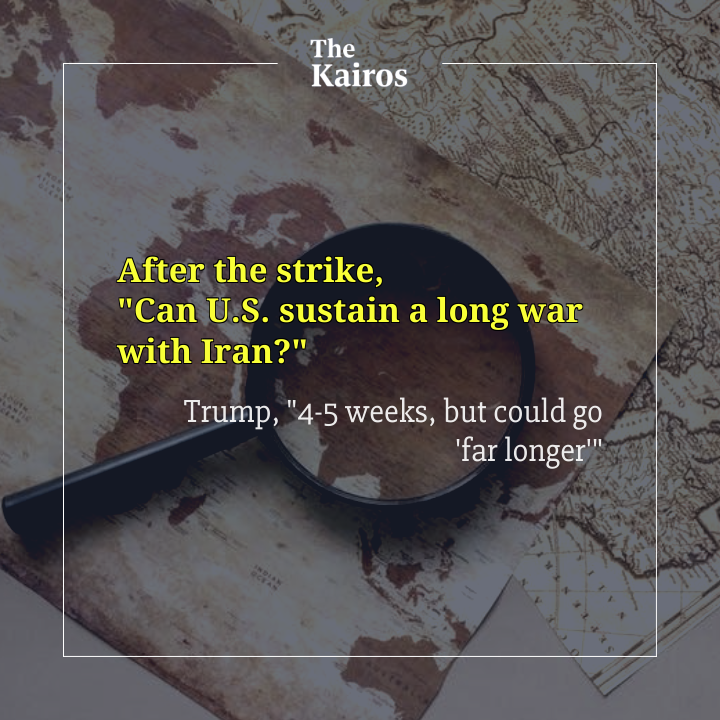
U.S. President-elect Donald Trump recently stated that the war would last “4 to 5 weeks,” while acknowledging that it “could take longer”. Realistically, a 4 to 5-week timeframe represents the maximum duration the U.S. can comfortably endure. Anything beyond that imposes significant strategic and economic burdens.
The primary bottleneck is the weapon inventory. Not only are U.S.-made weapons exorbitantly expensive, but they also require extensive production lead times. Furthermore, the U.S. is already directly and indirectly supplying arms to Ukraine and Israel, meaning the munitions required for these airstrikes are drawing from an already severely depleted stockpile. To sustain the campaign, the U.S. may be forced to pull critical reserves from military bases in Europe and other neighboring regions.

2. The Economic Shockwave: Oil Prices and Inflation
The Strait of Hormuz is the world’s most critical energy chokepoint, facilitating the transit of 30% of global crude oil and 20% of LNG.
Among developed nations, Japan is expected to suffer the most severe economic blow, whereas South Korea—currently in the process of diversifying its energy supply chains—may experience a relatively softer impact.
Market reactions have been swift: WTI crude oil is surging by approximately +6.3%, and the U.S. Dollar has strengthened by +1.4%. Over the past five years, relatively stable oil prices have anchored inflation, and the U.S. Dollar has maintained low volatility. However, this conflict is violently reigniting energy inflation and driving a flight to safe-haven assets.
For the Trump administration, navigating the risk of an oil-driven recession ahead of the midterm elections poses a daunting political burden.
3. A Geopolitical Chessboard: Isolating China
With more than 10 countries, including the US and Israel, currently involved, the world is closely watching whether a “short war” can be achieved. The 4-5 week airstrike campaign is laser-focused on one ultimate goal: “Regime Change” in Iran.
Iran occupies a highly strategic geographical position. It borders Russia and former Soviet satellite states to the north, accesses the Indian Ocean to the south, borders the path to China to the east, and points toward Europe to the west.
Some geopolitical analysts argue that the U.S. aims to install a pro-American regime in Tehran specifically to isolate China. Historical precedents underline this unique geographic value; for instance, the UK previously waged war in Iran precisely to block Russia’s southward expansion.
4. Defense Market Implications: Did South Korea’s M-SAM-II Prove Itself?
According to The Guardian, the UAE’s air defense network recorded a remarkable 93.6% interception rate during recent engagements. While this figure represents the combined performance of U.S. PAC-2/PAC-3, Israel’s Arrow, and South Korea’s Cheongung-II (M-SAM Block II), it strongly suggests that the Cheongung-II performed with an interception capability nearing 90%.
The primary beneficiaries of this conflict’s operational data are the manufacturers of interceptor missiles: LIG Nex1, Hanwha Aerospace, and Hanwha Systems. Reflecting this momentum, the PLUS K-Defense ETF recently closed with a massive surge.
Remarkable U.S.-listed ETF : SHLD


Leave a Reply